
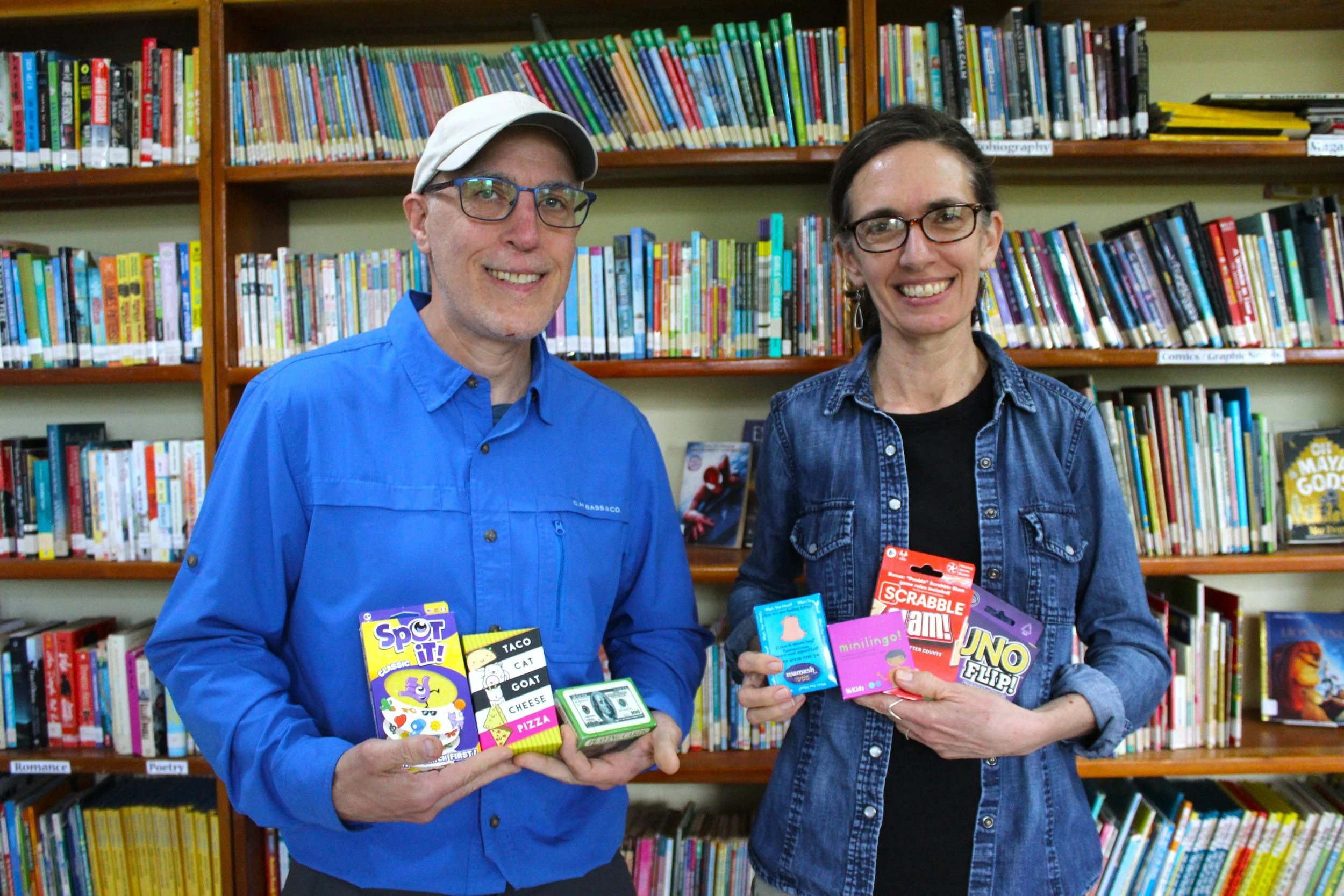
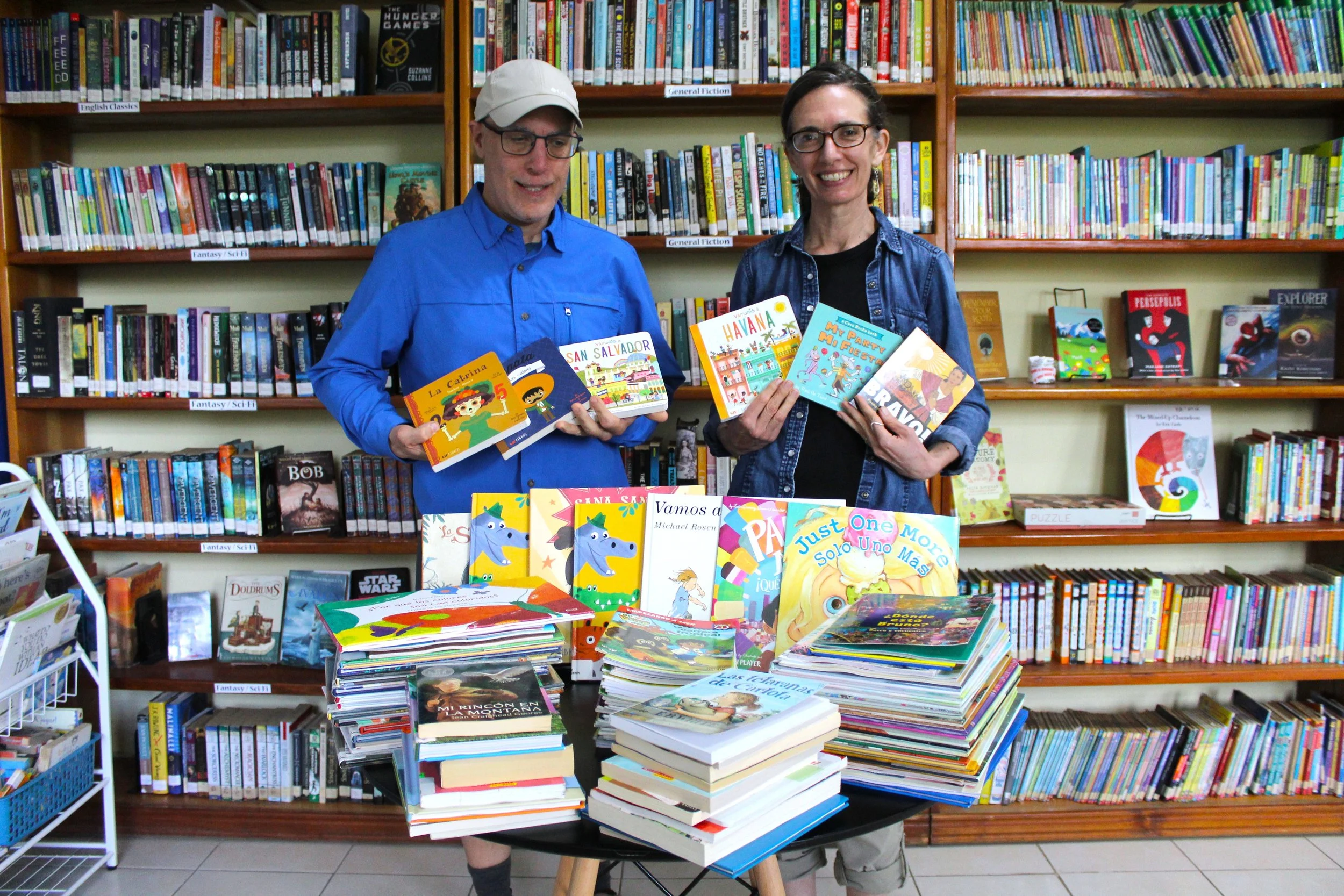
This month, we had the pleasure of interviewing Barb, who, together with her husband Chris, has shown great support for our community through their generosity. They participated in a garage sale, with all proceeds donated to our institution, and also contributed board games and more than 100 books to our library.
We invite you to read the article to learn more about what inspired them to support our students’ education.
How did you first learn about Na’atik, and what inspired you to become a donor?
I first learned about Na’atik. My husband and I wanted to do an immersion program, and I found two in Spain, but Spain in January is cold, and so I just went to the computer, and I just googled best immersion programs, and Na’atik was on the list. They had, like, this program is best for families. This is best for students. They had different categories, and Na’atik was one of those. I think it was for the best small class size or something about the instruction.
What made me become a donor? I am on the email list for Na’atik, so I know that they have needs, and they communicate those well, and my mom has wanted to do this garage sale for years. And it's not my thing, but she needed help, so I was supposed to help her get things ready, and my other siblings were going to help her actually do the sale. Well, that didn't happen. So all of a sudden, I ended up helping her with both getting ready and doing the sale, and I was a little annoyed. But I said, "Well, that's a great chance for me to go through my house and find stuff that I can bring into the sale", because usually we donate things we don't need to Goodwill or other charities. But I said, "Well, I could take that money I collect," and then Na’atik was just on top of my mind. I just thought that would be a good place to donate those funds.
What motivated you to support education and intercultural exchange?
There's two things. I was a teacher, so education. I taught mostly fifth grade kids, education and reading is important. Books are really important to me. Even though I taught science, it was a big part of my classroom instruction.
Oh, and then, so as far as intercultural, relating to languages, I remember being, like, five years old in a grocery store with my mom, and there were two women. I think they might have been from India, but I was too little, I don't remember, but they were talking to each other, and I knew they were speaking a different language. I had no idea what they were saying, but I could tell it wasn't the language I spoke, but they were having a conversation, and that was just fascinating to me, and I stood there with my mouth wide open, staring, and my mom's like: "Stop staring!" But I wasn't staring because I thought it was strange, I was like, "I want that." I wanted the ability to communicate with other people. And when I was in college, one of my teachers told me that you need to know at least two languages because ideas exist in one language that don't exist in your own language, and it just expands your worldview and your mind by learning about cultures, and language is just a key element to learning about a different culture.
Why did you decide to be involved not only as a donor, but also as a student?
My dream to learn Spanish started in that grocery store when I was five, but when I went to college, I had one semester of amazing instruction, and I decided at that point that I wanted to learn to speak Spanish. That's when I knew that Spanish was gonna be my language. But then, I didn’t have a good experience with my next Spanish class, and I kinda got discouraged, but I didn't lose the dream of learning a language. It was in my pocket, and then I lived life, and then now, at this point in my life, I have free time to dedicate toward learning a language.
What has learning within an intercultural community meant to you?
It's interesting to learn about the Maya as a culture, both in the past and then current, and learning history is one thing, but for me, the most important thing, is to make the connections with the families that you stay with here. I've had two different families. We were here last year and then again this year. They were both amazingly welcoming and just so interesting to learn about real people, not just the historical and cultural as a historical concept, but as real people.
What kind of impact do you hope your donation has on students and the wider community?
I hope that the students have a chance to learn language. They're so lucky to be able to learn as young people. As we get older, it gets a little more difficult. I hope that they're able to speak and to use English in whatever manner they want as become adults, because I just know that having that ability will open more opportunities for them, for, for their future, for themselves, for their families, for jobs. Whenever a person is bilingual, I'm always jealous because it is like a superpower that they have, so I'm hoping that the kids will have this superpower going into their adulthood.
Was there a specific experience at Na’atik that reinforced your decision to give?
Gosh, I don't know if there was one specific. When we were here last year, my husband and I, I think almost every day he was just like: "This is so great!". We loved everything about it, the whole experience, and he was just like: "The only thing I wish is that we would've done it for three weeks instead of two weeks." So this year, when we came back, we came for three weeks instead of two, because it was just... it's hard to pinpoint, but it was just, like, everything. We liked, you know, having meals with the family. We liked staying with the families. We liked the excursions. The classroom instruction is amazing. So I can't pick one specific thing. I'm sorry.
How would you describe the value of investing in education from your personal perspective?
For me, education, maybe I'm biased because I'm a teacher, but education is everything. Every education provides. No matter what you wanna do in life, having more education, whatever field or topic that is, it gives you more opportunities and experiences.
What would you say to someone who is considering supporting Na’atik for the first time?
I had a goal, an amount I wanted to raise, but it seemed like such a small amount, and it was really a small amount that we were able to raise. But I think the idea that every little bit helps, so, whatever you figure out to do, if you do a lemonade stand and you raise twenty dollars, that can help because it's the cumulative donations, the cumulative support that adds up.
What inspired you to organize a garage sale to support Na’atik?
Honestly, it was my mom's garage sale, and I just jumped on her plan. I have to give her credit because I wouldn't have thought to do that if she hadn't already had that in place. So it was kind of fortuitous, where things just kind of came together, right? She wanted to do this, and like I said, she's been talking about this for ten years. Um, and, uh, so yeah, I think that had that not happened, I don't know that... I don't know that... Hopefully, I would've still donated, but I don't know that I would've done this method, so I have to give her credit. If it hadn't... Opportunity presented itself, and I was like: "Okay, this is gonna work." So maybe that's the lesson, to try to figure out, you know, when things come up, kind of think: "Oh, how could I use this opportunity to maybe help another person or cause or something like that?"
How did it feel to turn something so personal and community-based into a way to give back to Na’atik?
I felt inspired, because we're planning to do it again next year. Honestly, garage sales and talking to strangers aren't my thing, but it was actually really fun to meet people. It was a good experience, and we hope to do it again next year.
How have your roles as a student and a donor influenced one another?
I hadn't thought about that. It's an interesting question. Well, I'm donating to Na’atik because of my experience, it's like I'm paying back. I feel that I got such a good experience, and I gained so much. When you receive, it makes you more excited about figuring out a way, “how can I help and support this organization?” And that was another thing, too. For Na'atik, their nonprofit element, I've always worked for nonprofits, whether schools or libraries or different organizations, and so that was another thing that really drew me to Na’atik, that part of their mission.
What do you hope for the future of Na’atik and the people it serves?
I hope that it continues to grow and expand and to serve more people in the community.
Thank you, Barb, for taking the time to speak with us and for sharing your experience, as well as your husband’s, as members of our community. We hope to welcome you back again soon!
To learn more about Na’atik’s English language program for local and Indigenous students in Felipe Carrillo Puerto, visit our Impact Page. We are only able to provide this much needed program thanks to the support of generous donors and the funds raised from our award winning Maya and Spanish Immersion Program. If you would like to support our mission please consider donating today or take a look at our immersion programs and online class packages.